Experiments with gene instructions
Thymulin gene therapy before and after disease
The asthma papers begin at different stages of lung disease. The endocrine studies begin with mice lacking a thymus. Those starting points deserve room.
Established asthma in mice
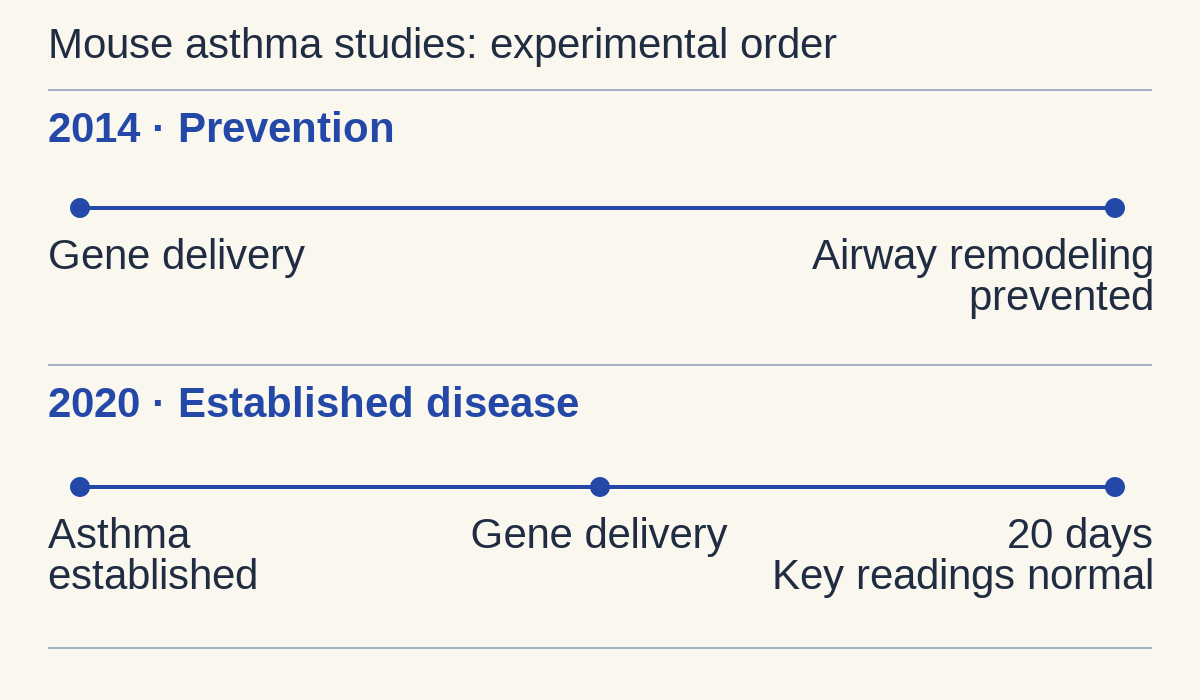
The 2020 asthma study began after allergic asthma was fully and stably established in mice. A single airway administration delivered thymulin-expressing plasmids in mucus-penetrating nanoparticles. At 20 days, key readings of inflammation, fibrosis and lung mechanics had returned to normal.
Of the experiments here, this one comes closest to the question I initially asked about the pancreas: can intervention change disease that is already present? Its answer is impressive within this mouse model. It was also gene therapy, with cells receiving instructions to produce thymulin. The result cannot be assigned to an ordinary peptide preparation or extended to people.
Preventing airway remodeling
The 2014 DNA-nanoparticle asthma study reported prevention of airway remodeling in mice: the lasting structural changes that can develop in airway walls. It contributes a prevention result beside the later experiment’s treatment of established disease.
The experimental order deserves to stay visible when those findings sit together. Both used gene-delivery approaches, and both concern mice. Their different starting conditions help explain why “prevents” and “reverses” ask different things of the evidence.
Mice born without a thymus
In the 2012 female-mouse study, neonatal thymulin gene therapy prevented ovarian dysgenesis and reduced reproductive abnormalities in animals born without a thymus. Related 2011 work on pituitary function reported preservation of LH and FSH and ovarian development after gene treatment on postnatal day 1.
The reproductive findings surprised me: I had mentally confined this hormone to immune cells, yet the thymus and the pituitary exchange hormonal signals, as the thymus-neuroendocrine review describes. But replacement in a mouse missing its thymus starts from a profound deficiency. It gives no direct answer about fertility treatment or aging in women.
Sustained production and human safety
Native thymulin has a short circulating lifetime, while its precise human pharmacokinetic half-life remains poorly established. The 2014 physiology review describes gene-delivery work intended to sustain thymulin, including a biologically active synthetic analog called metFTS in regulatable adenoviral vectors.
Sustained production is a substantial experimental achievement. My next questions concern control of that sustained intervention, its risks over time, and whether an appropriate human study could reproduce the benefit. The animal results leave those human safety and efficacy questions open. There is no approved human thymulin gene therapy.